Evangelising the restless hearts

St Augustine, one of the great Fathers of the Christian faith wrote these words 1600 years ago:     “You have made us for yourself, O Lord, and our heart is restless until it rests in you.”   Long before we become Christians, before we know the name of Jesus and understand anything about what he taught, we feel the truth of St Augustine’s words.  Our hearts are restless, searching for something, listening to a call which is beyond our human hearing but is as insistent and disturbing as a whisper in the wind.  Something, someone calls to us – and that someone is God. 

Some of our friends and neighbours have been aware of that whisper for a while and haven’t known what it is. It might be in that moment as they stand beside the seashore, or at the side of their child’s cot watching them sleep, and they just know that there is more to life than meets the eye.  

As Christians, as people who have come to know a bit more about God through knowing his Son Jesus, most of the time our task is really simple.  When people ask us ‘why do I feel so lost, why do I feel as though there is something more to be found?’  all we have to do  is to say ‘Listen. That voice you hear calling, that craving that you can’t satisfy, that restlessness in you – that is the voice of God calling you back to himself.  Let me tell you about Jesus who came to show us the way home.’ 

Because our friends and neighbours, like us, are being called home to the Father’s embrace, following Jesus, who has gone before us to prepare the way.   They may not recognise the caller but we know who it is and why he is calling.  And we know the Way. 

It’s not in the bread but the breaking

This poem by Gerard Kelly in his anthology ‘Spoken Word’ (published by Zondervan, 2007) comes back to me each Eastertide:

BREADSONG
It’s not in the bread
but in the breaking
that the mystery of God’s story is told.
It’s not in the seed
but in the dying,
not in the treasure
but in the digging for it.
It’s not in the mountain
but in its moving.

It’s not in the wine
but in the pouring out
that a new world is purchased
for the weary.
It’s not in the cross
but in the crucified,
not in the nails
but in the nailing.
It’s not in the grave
but in the rising from it.

It’s in the giving
that the gift becomes life;
it’s in the living
that the Word becomes flesh
.

It’s in this taking,
this receiving,
this sharing of a supper,
this pointing to a future
that is promised
and paid for
and pressed into our hands;
it’s in this everyday mealtime miracle
that the universe is born
to new life.

There is something in our modern psyche that focuses on things and destinations rather than on the making and using, and on the travelling. Perhaps it was always thus but somehow through the rose-tinted spectacles of history there does seem to have been more of a joy in crafting, carving, painting, making in the past. And where have the great explorers of the past gone, the James Cooks and the Vasco da Gamas and the Gertrude Bells? Those who travelled for the sheer joy of travelling, of knowing what was round the next corner, for good or evil?

Is it this modernist tendency which has made us consumers of the religious rather than disciples on the way? Do we take the bread and wine at Communion and ingest them as sacred artefacts rather than as signs of sacrificial giving? If my salvation is tied up not in the bread but in its breaking, how does that shape my view of its purpose and what kind of response does it call out of me?

It’s not in the seed but in its dying… How ready are we to die to self to allow the Word of God to truly grow in us?

Annunciation

If the bible were a huge cinematic blockbuster of a film, Mary’s ‘yes’ would be one of those breathless, luminous moments when the action pauses and the story turns.  Or if it was a roller coaster ride, this would be the moment at the top of the penultimate section, when the car has creaked and groaned its way to the very peak of the highest point and pauses for a heart-stopping moment before beginning the final swooping race down into the final sections, adrenaline pumping again, wheels barely holding the tracks.

Mary’s yes stands in a long line of yeses throughout the Bible, a long line of pauses before action:  Abrhaam’s unquestioning faith in offering his son, Moses’ hesitant stammering before returning to Egypt, Gideon’s fleeces before battle, and so on.  Each moment, a moment on which the world turns, a moment when mankind’s will meets God’s plan and a new chapter begins. 

But there is something different about Mary’s ‘let it be’.  Mary is not being asked by God to go out and do; Mary is being asked to allow God to become in her.  Up until this moment the story has mostly been an action film, full of kings and soldiers and heroic battles.  In contrast the start of Mary’s chapter is a love story, an acceptance of a task which is peculiarly intimate and self-denying which will change the world.

And yet this is not a passive task.  Bearing a child involves holding a space in which the other can become.  The womb is no flimsy receptacle but the softest and yet the strongest of muscles, capable of great gentleness, holding, nurturing; and yet strong enough to protect the fragile new life and then give birth. 

The child that is to be, until he is weaned, is completely dependent on the mother’s nourishment, bone of her bone, flesh of her flesh, and yet is also entirely other – a different person, a different essence yet made of the same stuff.  There is sacrifice here of one’s own being for the sake of another.

Neither is this a task without the risk of loss.  Anyone who has ever tried to have a child and failed will know how vulnerable one has to be, opening one’s heart to an overwhelming love and risking losing it all in a heart-beat.

On top of this, Mary faces social ruin, the loss of husband and family, the risk of losing her life even, as punishment for infidelity.  This is no easy ‘yes’ but a whole-life, risky response to God’s call.           

WH Vanstone in his book ‘Love’s endeavour, love’s reward’ talks about how love that is authentic is limitless, precarious and vulnerable. This is what we see embodied in this story of Mary’s ‘let it be’, her response to God’s limitless, precarious, vulnerable love is to offer herself in intimate recognition of his love for the world. 

Mary offers all that she has to give – physically, emotionally and spiritually – to allow God to work in her the miracle of becoming incarnate.

How ready are we today to make ourselves this vulnerable to God’s infinite love for his world, to be given a task which doesn’t call for the response of action and adventure and excitement but for the task of hope-full receptivity to the precarious thing that God is doing in and through us?  Not to passive inaction but to the radical holding of a space in which God can become, sacrificing ourselves a little at a time to the new thing that is coming into being?

 And when the time comes will we have the strength not to hold on to the thing that God has created in and through us but to let it go, to give it the freedom that it has to have to do the thing that God has called it into being for, even though, in the letting go, it will feel as though a sword has pierced our own souls.

May God give us the strength to respond ‘let it be’ in our own lives today.    Amen           

Starting the dialogue

During the first half of last year I visited every clergy Chapter, and hosted 10 ‘lay’ evening workshops, to open a conversation with clergy and lay leaders about achieving financial sustainability through being more intentional about discipleship.

Analysis of average giving per person per week, parish by parish, across the diocese showed that in a small number of churches the average giving per person was almost twice as much as in the rest, £15-25 per week compared to £5-10 in most other churches.  The defining characteristic of those churches in the higher giving group was that they were more intentional about their discipleship: more opportunities for bible study and home groups, more intentional in praying for one another corporately and individually, more likely to invite people who were part of the wider fellowship of the church to make a commitment to Christ.  The underlying deprivation of the parish was not a factor – the difference is discipleship – make disciples and people give more generously, in gratitude for a deeper understanding of who God is and what Christ has done for them. 

The conversation began with the question ‘What more could you do in mission if you weren’t anxious about money?’ and flowed from there.  I showed them the analysis that had been done and then we talked about how they might be more intentional about discipleship in their own setting.   I listened carefully to their experience – in many churches there has been no active ‘discipling’ of the congregation for 10 or even 20 years.  Many clergy felt dispirited and disabled, they felt that their people were so far back in the journey, they didn’t know where to start to get them engaged in growing as Christians again. 

Dialogue helped overcome the sense of hopelessness and the language barrier.  The language of discipleship is quite alien to many clergy – obviously they understand what it is to be a disciple but in many traditions the word ‘discipleship’ as a task or intentional activity is not comfortable.  Similarly when I talk about ‘making a commitment to Christ’, that needs to be translated across traditions.  In the evangelical setting in which I’m most comfortable we might suggest that someone ‘prays a prayer of commitment’ or I might offer to pray for them, that they might receive the Holy Spirit.  This doesn’t sit comfortably with everyone so we looked for other ways of saying the same thing: when did you last invite an adult to consider baptism, for example, or invite them to consider confirmation? 

By interpreting language across traditions, and by offering simple models of thinking about discipleship, we began to see more people engage with the elements of ‘making disciples’ – creating a culture of invitation and developing opportunities for people at every stage of the discipleship journey to be invited to.    We need to do more, though, to create a culture where taking people on a journey of deepening faith is the norm in every church, whatever that might look like in individual settings and traditions. 

Intentional discipleship will lead to more financially sustainable churches – the data shows a direct correlation and I can see the causation – but that isn’t why we are doing it.  We are committed to making disciples because that is how we will bring more people into a life-giving relationship with Christ, to acknowledge that Jesus is Lord.  We want to see God’s kingdom come in our communities.   

Discipleship

The 2016 publication from the Anglican Consultative Council ‘Intentional Discipleship and Disciple-making’ is one of the most useful documents I have read in this field, partly because it draws on models and ideas about discipleship from all around the world and across many traditions. Their definition of discipleship is the ‘total God-ward transformation which takes place when individuals and communities intentionally, sacrificially, and consistently live every aspect of their daily life in commitment to following Jesus Christ. Therefore, to be a disciple is to follow, and the nature of that discipleship is defined by the One we follow.’

Making disciples they say ‘is to have been transformed as we follow him who calls us so that we share in the calling and lifelong transformation of others.’ It is a natural process; the more we grow to be like Christ, the more we reflect his glory, the more we will inspire the transformation the world around us if we live out our calling where it can be seen. It’s not complicated …. but it is hard.

A key aspect of being intentional about discipling others is to invite people into relationship with us and to point to Jesus as we walk with them. At the beginning of John’s Gospel, Andrew meets Jesus and the first thing he does is to go and find his brother Simon: ‘We have found the Messiah’ and he brought his brother to Jesus. Philip invites his friend Nathaniel to ‘Come and see’. To do this, churches have to have something to invite people to at each stage of their discipleship journey and a culture of invitation. The only quality needed by the disciple-maker, it seems, is that they are one step ahead of the person being invited – ‘I have found …. come and see’.

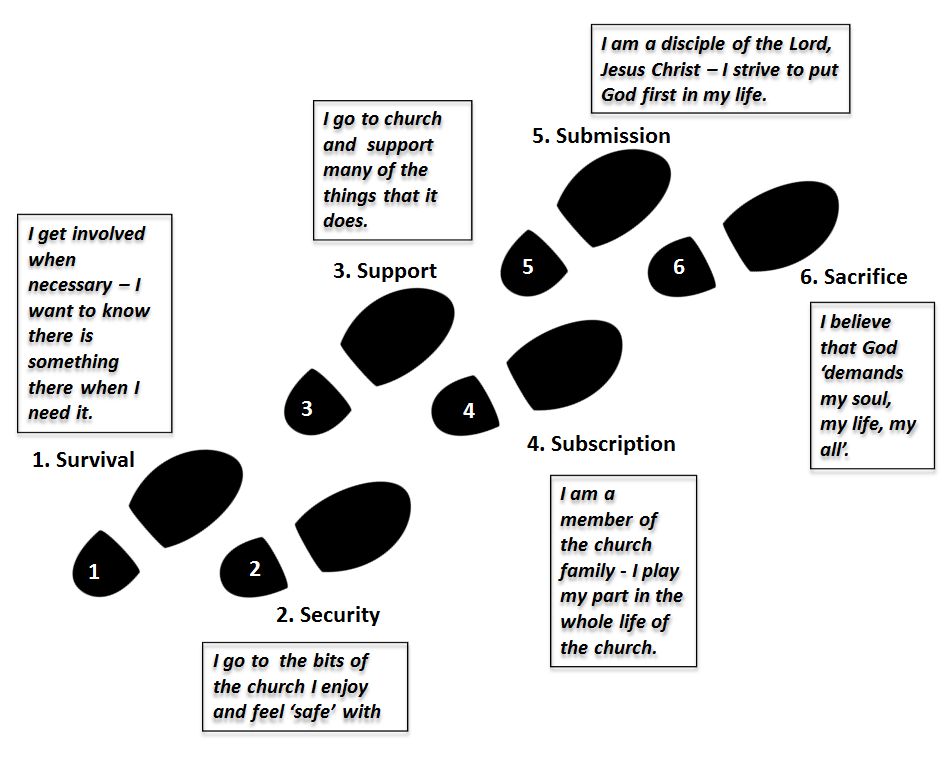
Using a model adapted from an understanding of how people develop a relationship of giving in church life, I have been using discipleship footprints to help parishes diagnose whether they have the right elements of a journey of deepening faith to which disciples at every stage can be invited. From ‘I think there might be something more to life than this’, through ‘being okay with things which make me feel secure’, on to ‘supporting the church’ and then ‘belonging to church’, and finally the big leap to submission and on to sacrifice. Then we can set about enabling all the people of God to feel comfortable in inviting people to take another step forward.

This is a longitudinal model of discipleship, the journey of faith. The ‘Intentional Discipleship’ document describes the horizontal plane, eight foundations of discipleship to which I have (cheekily) added a ninth:

‘Giving’ as a means of discipleship is rarely mentioned in the literature on discipleship and yet in Matthew 6 Jesus talks about alms giving in the same breath as prayer and fasting. (And yes, I realise fasting ought to be in the model too but 9 is such a good number for drawing diagrams…) I would want to argue that giving is not just a fruit of discipleship but also a means of growing discipleship but that’s for another day.

The arrows on the diagram are, again, moments of invitation. Someone has been engaged in a fellowship activity in your church for a while, who will invite them to engage in an act of service, maybe helping out at the Foodbank? Someone has been attending Sunday morning worship for a while (an activity which has a little bit of most of the elements of discipleship), who will invite them to deepen their understanding of Scripture by inviting them to a bible study group?

And the key question: someone has been coming to Messy Church for a while – who will invite them to make a commitment to Christ through baptism and on into the Eucharistic life of the church family?

These models aren’t perfect but they have been useful in helping people think systematically about discipleship in their churches and to be intentional about filling the gaps. We are not looking for perfection – we are just wanting to be a little bit better at what we do. The Lord does all the rest. ‘Come and see.’

Paying attention

“Attention, taken to its highest degree, is the same thing as prayer. It presupposes faith and love. Absolutely unmixed attention is prayer.”   Simone Weil

This morning I woke in a retreat house on the southern edge of the North York Moors.  It sits at the top of the slope down to the vale below and the Howardian Hills can be seen rising in the distance.  It is mid March and the fields are white with a light frost, the trees bare, waiting for the spring.  As the sun rises, from behind the hill, the frost melts and it is as though a green curtain begins to creep down the side of the valley.  Birds sit high in the tops of the trees, the first to welcome the dawn and the warmth of the sun.   

There is a path leading from the house up the side of the valley, gently rising until lost in the trees at the top of the far slope.  I wonder where it goes and what might be on the other side of the hill? 

Praise the Lord. Give thanks to the Lord, for he is good; his love endures forever.

Community Resilience

A recent report by the think tank Theos entitled ‘People, Place, and Purpose: Churches and Neighbourhood Resilience in the North East’ (Paul Bickley, 2018) argues that churches have a significant role to play in helping to build community resilience, especially in areas of multiple deprivation. He sets out a model whereby resilience is built through the development of three forms of capital: social capital, the capacity for the building of trust, reciprocity and co-operative action; physical capital, buildings, community spaces and other resources; and spiritual capital, those ‘intangible factors which contribute to a sense of hope’.

Local churches can clearly contribute in all three of these arenas. Many of our churches host all manner of groups to which people can belong, building relationship and human networks. In addition, many of those groups have an outward-focused purpose, creating an environment in which active collaboration for the good of the community can happen.

Churches are also stewards of public spaces – church buildings, church halls and often open spaces in the form of churchyards. Increasingly, church buildings are finding additional functions and are being developed to facilitate community engagement, creating spaces in which children’s parties, adult education, slimming clubs and dance classes can happen. There is also a growing acknowledgement of the importance of simply being there as a space of quiet reflection, for community gatherings at times of crisis and celebration, and as a place of beauty in an otherwise drab or disheveled environment.

The third area, the building of spiritual capital, is the area where perhaps more work could be done in a more explicit way. This is the often overlooked significance of preaching Good News in a place. The report talks about the importance of churches having a narrative of ‘what if..?’ instead of ‘if only…’ and of them being places which hold the community story, keeping community memory alive in the stories that are told and offering a space for celebration and the making of new stories. Finally, churches are places where we narrate the future, telling the story of hope for a place.

Every Christian leader needs a really good theology of hope, a secure understanding of where our hope lies in the ‘now and not yet’ of realised eschatology. Places of poverty are places where signs of God’s kingdom and his decided preference for the poor are already present and waiting to be noticed. Luke’s gospel is clear ‘Blessed are the poor’ – not ‘the poor will one day be blessed in heaven’, but God is present and blessing the poor today in our communities. Sometimes, in the sheer brokenness of an unjust world, those signs are not easy to spot but we believe, as Christians, that they are. And when we believe this to be true, by faith, we look and we find.

The church tells stories about God and what he is doing in his world. We tell stories about our communities and how God is at work in them. And those stories are stories of hope, cleansing and reviving rain in parched deserts. We can change the story in our places if we preach Good News, always and everywhere. Other organisations are good at building social capital and can contribute physical capital but our particular strength is building spiritual capital.

A number of contributors to the Theos research talked about people in their communities showing all the evidence of defeat: “When we first moved here my daughter said “Dad look at the people”. When you walk along the street it’s easy to be struck by the number of people who appear defeated.” We believe as Christians that Christ won the battle against evil for us by his death on the cross. We know that we are not defeated, that the victory is already secured. We have the words of hope that our communities most need to hear.

Qualities of leadership

A quote from the Bishop of Salisbury’s New Year message in 2019:

‘ A friend in the Management School at Bath says that what builds trust in organisations in difficult circumstances is that they are led by people with ability, benevolence, integrity and predictability so that you know where you stand even when you disagree, perhaps particularly when you disagree.’

I like this. It reminds me of all the best leaders under whom I have served. Predictability is probably the quality that surprises most people but my experience is that it is essential, especially if you want to build a good team. We cannot work effectively together if I cannot guess from moment to moment what you are going to do, or what you want me to do in any given circumstance. That level of mutual understanding and trust takes time to build but it is absolutely worth it.

One of my favourite models of leadership is the ‘air steward’ model. I encourage leaders to develop a ‘non-anxious presence’ and to make that visible, especially in times of crisis. If everyone on the plane looks at the air steward and she or he is calm, everyone relaxes. But if the steward appears nervous, ill at ease or panicky, everyone begins to panic. In a crisis on a plane, the steward may appear to have no active role in managing the situation – it is the pilot and the co-pilot who are wrestling with the controls. But the non-anxious presence in the cabin is absolutely essential in the plan.

How you are matters as much, if not more, in leadership than what you do. Ability matters but so does character – benevolence (‘love one another’), integrity, and the predictability which comes from being ‘not anxious’. The most common commandment in the Bible is, of course, ‘Do not be afraid’.

Creating a local theology

Recently I came across the notes I made after a Central Readers’ Council AGM from a few years ago. It was enlivened (as it always was) by the closing address by Bishop Robert Paterson (Bishop of Sodor and Man) and then Chair of the CRC. I noted 3 interesting ideas which still seem to have currency for me as my thinking has evolved.

The first is the evergreen question of what it is to be ‘Reader’ in the Church of England. Bishop Robert suggested that Readers are primarily ‘lay theologians’ – distinctively lay in that they are more ‘in the world’ than ‘in the institution of the church’; and recognising that they are theologically trained and ‘formed’ in ministry to a level which is not far short of what we expect for our ordained clergy. I rather like this definition of ‘lay theologian’ – it acknowledges the authority under which Readers do what they do without in any way limiting the scope of their affairs – they are ‘about the business of their heavenly Father’ as Jesus would say. And there is a presumption that they are about the business of ‘Good News’, which is focused around preaching, teaching and leading others in worship, as well as being involved in the more incarnational aspects of God’s mission.

The other ideas stem from Bishop Robert’s 2 definitions of preaching. His first definition was that preaching is about re-creating a meeting between Christ and his people. To illustrate this he contrasted the idea of a ‘birthday’ in its familiar sense and a liturgical ‘birthday’. In the former, we remember as a historical event something which happened some time ago (quite a long time for some of us….) but there is no sense in which we can recapture or relive the event itself – we don’t go back to the feeling of being a newborn. But liturgical birthdays as celebrated in the liturgical year are all about re-living the Gospel events today and in this place, re-encountering Christ ourselves, just as his family and first disciples did, each time we remember the first Christmas, Easter, Pentecost etc. Preaching is at the heart of this experience – we re-encounter Christ as a community through the preaching of the Gospel in today’s world.

The final idea is Bishop Robert’s 2nd definition of preaching which is that it is the principal mechanism for creating (or moulding), over time, a community theology. Now this is an idea I like a lot and which has huge implications for the way we see ‘Ministry Teams’ in our churches. If preaching moulds the community theology – the way we think and speak about God here in this place at this time – then the shaping of the theology of the whole ministry team is critical in developing a coherent community theology since each member of the team will contribute their part of the whole. Since churches are communities which are defined primarily by their relationship to and understanding of God – theocracies not democracies – then the role of the ministry team (ie specifically those who preach) in developing and shaping the community is central as they are the ones who are constantly pointing to God to interpret and make sense of the way our world is, locally as much as globally.

I wonder if sometimes we have lost sight of this idea a bit in some churches? It seems to demand that we invest much more time and effort in shaping a coherent theology within our ministry teams so that the team is able, as a team, to shape the theology of the community. It re-emphasises the importance of a good, consistent theological foundation on which the whole ministry team can draw so that we have not just ‘good’ preaching, but effective preaching, preaching which shapes and moulds the community spirit. Our preaching must be not just technically proficient but Spirit-driven and Christ-centred, freeing people rather than chaining them. Ponder Matthew 24 – Jesus says ‘Woe’ to the scribes and Pharisees who bar the gates of heaven to those who would enter and do not go in themselves. Not just a historical criticism, I think, but one we would all do well to take notice of.

Who watches the Watchmen?

Who watches the watchman? This is the motto written on the side of Commander Vimes’ truncheon in the Discworld novels written by Terry Pratchett. Sam Vimes is the Commander of the Ankh Morpork Watch – their police force – who is renowned for his integrity. In the book ‘Thud’, Vimes is infected by a supernatural influence called ‘The Summoning Dark’ which metaphorically swims through the city of his unconscious looking for an opportunity to take control of the policeman through fanning and directing his rage. As the Summoning Dark swims, however, it hears the steady pursuit of heavy footsteps which eventually turns out to be Vimes’ internal ‘Watchman’, an aspect of his unconscious which constantly patrols the city of his mind.

I love Terry Pratchett’s books. I think many of the ideas he plays with in his fantasy world of Discworld are hugely insightful – read ‘Carpe Jugulum’ for an interesting discussion of sin, evil and religion and ‘A Hatful of Sky’ for some very good ideas as to how we should train our curates….

But this idea of ‘Who watches the Watchman?’ has always resonated strongly with me. Part of the Ordinal describes priests as being ‘messengers, watchmen and stewards of the Lord’, watching over the people of God, watching for signs of God’s kingdom. But who watches over our parish clergy? The Bishops, Archdeacons and Area Deans have this role, of course, but they are geographically distant from most clergy much of the time. So it is really important that the watchmen over our parishes set a watch over their own lives, constantly patrolling the boundaries of healthy behaviour and relationships in the parish and beyond. And not just clergy but anyone in leadership who doesn’t have someone in authority close by to help them stay safe. Perhaps this metaphor of a patrolling policemen through the city of our minds could be helpful for some?