

The 2016 publication from the Anglican Consultative Council ‘Intentional Discipleship and Disciple-making’ is one of the most useful documents I have read in this field, partly because it draws on models and ideas about discipleship from all around the world and across many traditions. Their definition of discipleship is the ‘total God-ward transformation which takes place when individuals and communities intentionally, sacrificially, and consistently live every aspect of their daily life in commitment to following Jesus Christ. Therefore, to be a disciple is to follow, and the nature of that discipleship is defined by the One we follow.’
Making disciples they say ‘is to have been transformed as we follow him who calls us so that we share in the calling and lifelong transformation of others.’ It is a natural process; the more we grow to be like Christ, the more we reflect his glory, the more we will inspire the transformation the world around us if we live out our calling where it can be seen. It’s not complicated …. but it is hard.
A key aspect of being intentional about discipling others is to invite people into relationship with us and to point to Jesus as we walk with them. At the beginning of John’s Gospel, Andrew meets Jesus and the first thing he does is to go and find his brother Simon: ‘We have found the Messiah’ and he brought his brother to Jesus. Philip invites his friend Nathaniel to ‘Come and see’. To do this, churches have to have something to invite people to at each stage of their discipleship journey and a culture of invitation. The only quality needed by the disciple-maker, it seems, is that they are one step ahead of the person being invited – ‘I have found …. come and see’.
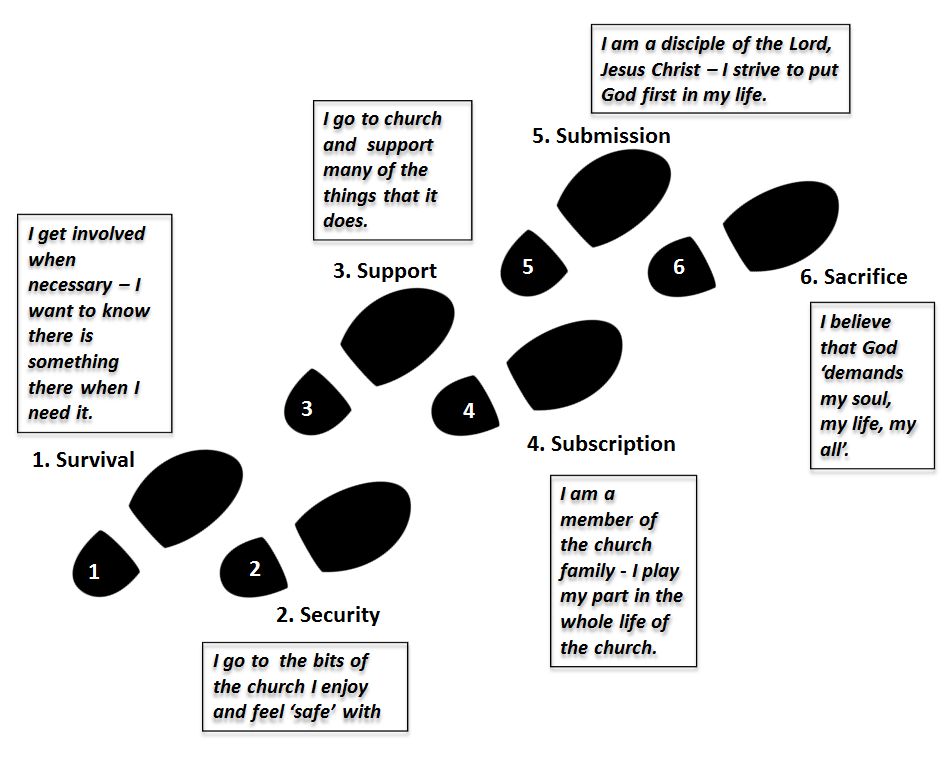
Using a model adapted from an understanding of how people develop a relationship of giving in church life, I have been using discipleship footprints to help parishes diagnose whether they have the right elements of a journey of deepening faith to which disciples at every stage can be invited. From ‘I think there might be something more to life than this’, through ‘being okay with things which make me feel secure’, on to ‘supporting the church’ and then ‘belonging to church’, and finally the big leap to submission and on to sacrifice. Then we can set about enabling all the people of God to feel comfortable in inviting people to take another step forward.
This is a longitudinal model of discipleship, the journey of faith. The ‘Intentional Discipleship’ document describes the horizontal plane, eight foundations of discipleship to which I have (cheekily) added a ninth:

‘Giving’ as a means of discipleship is rarely mentioned in the literature on discipleship and yet in Matthew 6 Jesus talks about alms giving in the same breath as prayer and fasting. (And yes, I realise fasting ought to be in the model too but 9 is such a good number for drawing diagrams…) I would want to argue that giving is not just a fruit of discipleship but also a means of growing discipleship but that’s for another day.
The arrows on the diagram are, again, moments of invitation. Someone has been engaged in a fellowship activity in your church for a while, who will invite them to engage in an act of service, maybe helping out at the Foodbank? Someone has been attending Sunday morning worship for a while (an activity which has a little bit of most of the elements of discipleship), who will invite them to deepen their understanding of Scripture by inviting them to a bible study group?
And the key question: someone has been coming to Messy Church for a while – who will invite them to make a commitment to Christ through baptism and on into the Eucharistic life of the church family?
These models aren’t perfect but they have been useful in helping people think systematically about discipleship in their churches and to be intentional about filling the gaps. We are not looking for perfection – we are just wanting to be a little bit better at what we do. The Lord does all the rest. ‘Come and see.’
 Dorothea